
How to Improve Your Triathlon Running
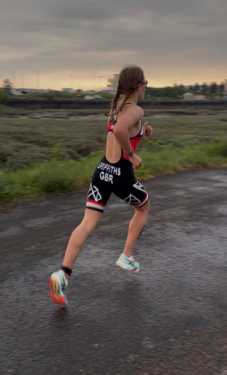
Author: James Beckinsale M.Sc (Sports Sci) BTF L3 - High Performance Coach: June 2026
Whether you are training for an Ironman, a short-course triathlon, or simply trying to improve your 5K or 10K times, there are several key components that need to come together to maximise your running performance.
Over the coming weeks, this “How to Improve Your Running” series will explore the most important areas of running performance and economy.
For me, one of the first and most important pieces of the puzzle is running cadence — or what I prefer to call strike rate.
Optimal Running Cadence (Strike Rate)
In this first article, we look at running cadence, or strike rate. Both terms refer to the number of steps you take per minute while running.
Cadence can be measured:
Using both feet combined (e.g. 180 steps per minute)
Or using one foot only (e.g. 90 steps per minute)
Understanding and improving strike rate can have a huge impact on running economy, injury prevention, and overall performance.
Learning from the Best
If we study the world’s best middle-distance runners and triathletes — male or female — we consistently see a strike rate of around 98 steps per minute (one foot) (approximately 196 total steps per minute) when racing at speed.
It is important to analyse elite athletes while they are truly racing, rather than pacing tactically or running easy. When athletes are slightly off form, fatigued, or simply not pushing race pace, cadence often drops slightly. To understand optimal mechanics, we need to observe them at their very best.
Of course, there are occasional outliers due to height or biomechanics, but remarkably, the very best athletes tend to converge around this same strike rate.
Elite Examples
Triathletes
What About Age-Group Athletes?
When we analyse age-group triathletes and runners, cadence is often much lower. Many recreational athletes run in the low 80s, while stronger middle- and front-of-pack athletes are often closer to 90+ steps per minute.
This raises some important questions:
Are they over-striding?
What is their injury history like?
How efficient is their running economy?
How much energy are they wasting oscillating? (moving side-to-side or up-and-down)
In my experience, most age-group athletes benefit enormously from improving strike rate. Not only does running economy improve, but injury rates often decrease as well.
One of the most common pieces of feedback I hear from athletes after increasing cadence is:
“I finally feel like a runner.”
Why Is Strike Rate So Important?
It all starts with alignment and the body’s kinetic chain.
A lower strike rate often leads to over-striding, where the foot lands too far in front of the body instead of underneath the centre of mass. This can creates braking forces, more load and prevents the correct muscle groups from activating efficiently.
Runners who over-stride often develop a “pendulum-style” gait, relying heavily on the quads and hip flexors to swing the leg forward.
Efficient runners look very different.
The best runners move with a far more cyclical running pattern, driven primarily by:
Glutes
Hamstrings
These are the body’s most powerful muscles and allow the athlete to generate greater propulsion and better efficiency with every step.
When foot strike occurs underneath the centre of mass, runners can also tap into the body’s incredible elastic energy system — something we will explore further in future articles.
The Beauty of Efficient Running
Watch elite runners closely and several things immediately stand out:
Greater hip angle/ extension
Longer, more fluid stride length
Exceptional “float” or hang-time
Minimal wasted movement
Perhaps most impressive is the lack of unnecessary oscillation. When elite runners move together in a pack, it almost looks effortless — as though you could balance a cup of tea on their heads without spilling a drop.
It truly is poetry in motion.
How to Increase Your Strike Rate
Most age-group athletes can benefit from gradually increasing cadence, whether the goal is:
Reducing injury risk
Improving economy
Running faster with less effort
Start by measuring your current strike rate:
Count one foot hitting the ground for 60 seconds at race pace
Or use a GPS watch that tracks cadence automatically
What did you get?
To begin improving strike rate, try short, focused intervals:
15 seconds aiming for 25 steps
30 seconds aiming for 49–50 steps
Repeat for 8–10 repetitions
The goal initially is simply to develop rhythm and awareness.
Training with a runner who already has a high cadence can also be extremely effective. Matching their rhythm helps avoid overthinking and promotes natural learning through visual imitation.
A metronome app can also work very well when training alone.
How Long Does It Take?
Adapting to a higher cadence takes time.
Initially, it can feel unnatural — almost as though you are taking tiny “piddly” steps. This is completely normal.
Developing the strength, coordination, and neural pathways required to hold a higher strike rate under fatigue may take several months, but with consistent practice, you will feel the benefits after 6 weeks.
As fatigue builds during races or long sessions, the body naturally wants to revert to old habits and lower cadence patterns. This is where strike rate becomes not only a physical tool, but also a psychological one.
Focusing on cadence during difficult moments helps athletes stay positive, engaged, and present (thought associated process)
Expected Improvements
Improving strike rate naturally strengthens:
Running muscles
Tendons
Fascia
Ligaments
Over time, athletes often experience:
Improved running economy
Greater stride efficiency
Reduced injury risk
Faster running speeds
Remember:
One of the biggest limiting factors in white endurance athletes is often a lack of strength.
Coming Next…
In the next article, I’ll take you through what I believe is one of the true secrets to running performance…
