
You should race an Ironman a week before your Ironman
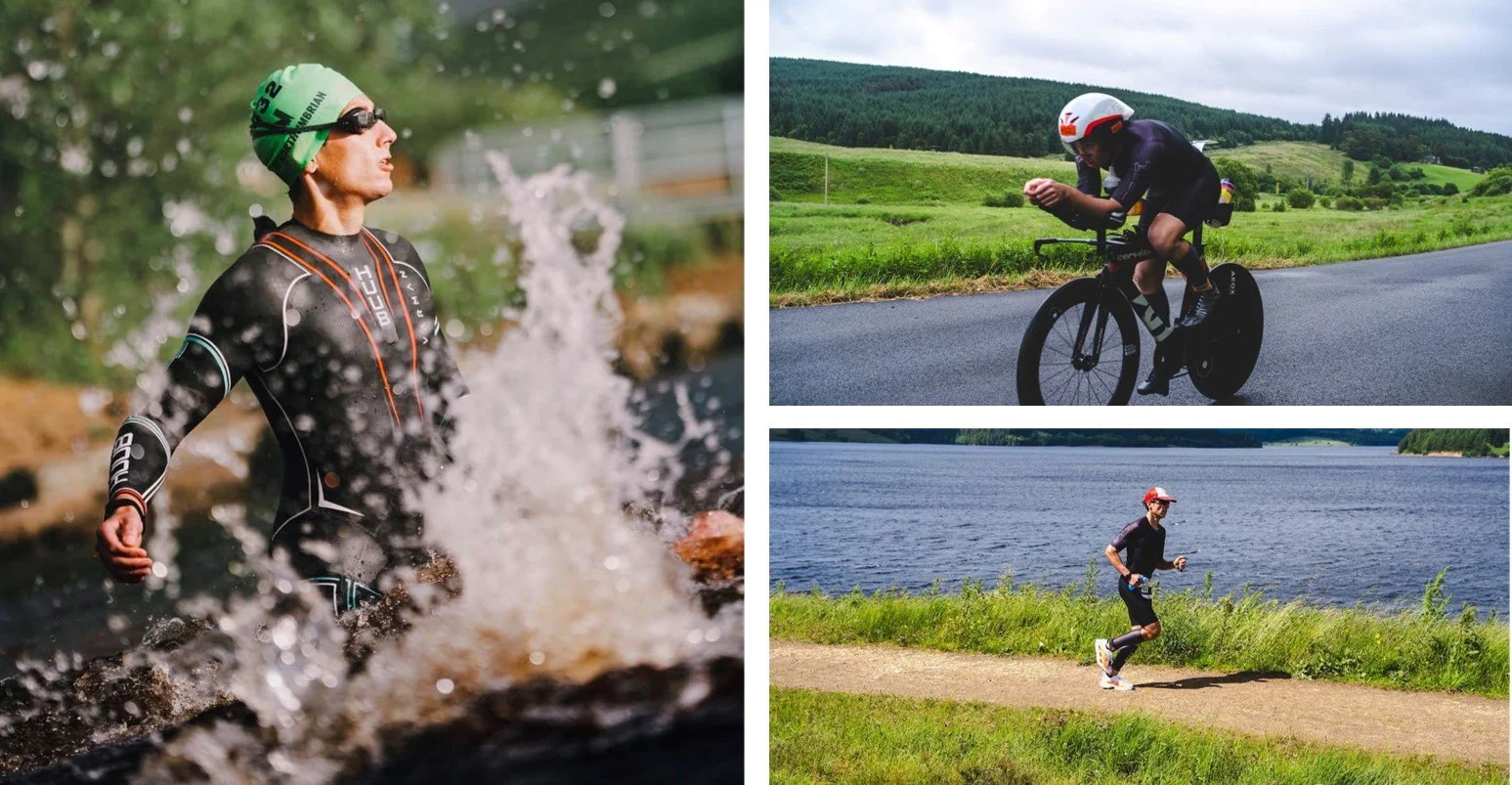
Alex Northumbrian IM June 2026
On 28 June I won the full-distance Northumbrian Triathlon. A week later, on 5 July, I raced Challenge Roth. Northumbrian took 10:05. Roth took 9:01:58. They were both awesome experienced.
This is probably not standard tapering advice, and coach James told me not to do it.
I was already heading to Northumberland to support Rachel, who was racing the middle distance, and switched my own entry from middle to full the day before the race. I had been trying to race Roth for the past three years. Northumbrian was less of a plan, more a last-minute hypothesis test and just having fun.
The objective of training was not just to accumulate fitness but to alter the physiological profile required for Ironman performance. The primary variables were increasing VO₂max, decreasing VLaMax, increasing High Intensity Threshold Power (HITP), increasing Low Intensity Threshold Power (LITP), and improving durability. In practical terms this meant increasing the fraction of VO₂max sustainable for nine hours while simultaneously reducing glycolytic contribution at race intensity.
The majority of bike training therefore consisted of progressively extending accumulated work around threshold, high volumes of low-intensity work to increase total aerobic load, low-cadence torque work to increase force production and oxidative recruitment of higher-threshold motor units, and just enough work above threshold to preserve VO₂ kinetics and maximal cardiac output without excessively increasing VLaMax. The run followed essentially the same philosophy, although constrained by musculoskeletal durability rather than cardiovascular capacity. Swimming remained the obvious weakness because, unlike cycling and running, technique dominates physiology until technique stops being the limiter.
My only real concern before the two races was the swim.
At Northumbrian the swim was pretty poor. I went off course and did nearly 500m extra, which is an impressively inefficient way to start an Ironman. This was useful because the problem was not fitness. It was the execution. I was not sighting well enough, I was not using the available reference points properly, and I was letting the open water problem happen to me rather than controlling it. In a pool, the black line does a lot of thinking for you. In a lake, unfortunately, you have to be the black line.
Things picked up on the bike. Someone shouted that I was 6th out of the water, so I tried to count the people I passed. I probably got distracted by the cute lambs and fluffy sheep we shared the course with (some of which were on the road!) because I only counted two passes.
The bike was deliberately controlled. A third of the way through we were visited by a rainstorm, so I dialled the effort back because carbon rim brakes in the wet rarely inspire confidence on British roads. I ended up riding both laps within 1w of each other: 222w and 221w. Heart rate drift was very limited, which was a good sign that the metabolic cost was under control and that I was riding at an intensity I could absorb rather than an intensity I could merely survive.
That was probably the most useful data point of the day. In training terms, Northumbrian functioned as a long steady-state durability test. If you can ride two laps at essentially the same power, with little cardiac drift, in bad weather, on a course with livestock, then the basic aerobic machinery is probably working.
I started the run with a solid lead, which confused me greatly because I thought there were a few people still up the road. The run was very scenic, probably my favourite course so far, and although it had plenty of up and down, the soft surface compensated for the impact. A 3h15 felt comfortable. That mattered more than the win, although winning was a nice bonus.
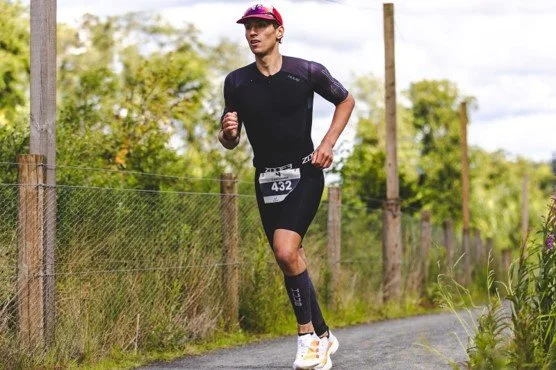
Northumbrian IM
The run confirmed something I had been trying to train for specifically: not just being able to run after biking, but being able to run without the first 10km feeling like a negotiation with the hamstrings. The training had included enough long runs, bricks, threshold work and race-pace running to make the pace familiar. But there is still a difference between believing a model and having a recent data point. Northumbrian gave me the data point.
The week between the two races was low volume, lots of snacks, lots of naps. I trained every day, but my longest run was about 6k, my longest swim was about 1.5k, and my longest bike was 75 minutes. This was basically a taper by volume reduction rather than by inactivity. Frequency stayed in, intensity touched the system lightly, but the main goal was to shed fatigue without letting the body forget what sport it was meant to be doing.
Despite the video circulating of Felix dumping ice into the canal, the water at Roth manifested its inner stew and became a non-wetsuit swim. I came out in 1:09, four minutes slower than my wetsuit saltwater swim in Copenhagen, but a reasonable time given the conditions. More importantly, it was not a repeat of Northumbrian. I sighted properly, stayed engaged, and did not add a bonus sightseeing loop.
The bike was disappointingly slow. Despite starting out at 260w for the first hour, against a 240w target, the speed was never where I wanted it. I stuck to the plan and averaged 237w, 250w NP, which is pretty much the correct Ironman execution from a physiological point of view and a deeply irritating execution from a “why am I not going faster?” point of view.
The charitable explanation is that the pacing was disciplined and the run result justified it. The less charitable explanation is that I need a new bike.
My fun fact is that I may have set a record for consuming the most nutrition: about 185g of carbohydrate an hour on the bike, no stomach issues, and similar on the run. This was not quite as random as it sounds. The whole point of the training and nutrition practice was to make carbohydrate availability a non-limiter. At Ironman intensity, the aim is to preserve muscle glycogen, keep exogenous carbohydrate oxidation high, and avoid turning the marathon into a low-blood-sugar personality test. It worked. I ate like a lab experiment and, for once, the lab experiment did not explode.
The run is probably the bit I was happiest with. Doing Northumbrian the week before and finishing with a comfortable 3h15 gave me the confidence to settle into 3h00 pace at Roth. The final time was 3h00m56.
That is the useful bit. Without Northumbrian, I think I would have run more conservatively. I would probably have started at 3h15 pace, called it sensible, and then spent the second half trying to undo the maths. I always prefer a flat or negative split pacing strategy anyway, but there is a point where caution becomes a time penalty. By the time I had enough confidence to bring the average down, I would have needed to run 2h45 pace for the last half. Even if I could sustain that, I definitely could not have run faster.
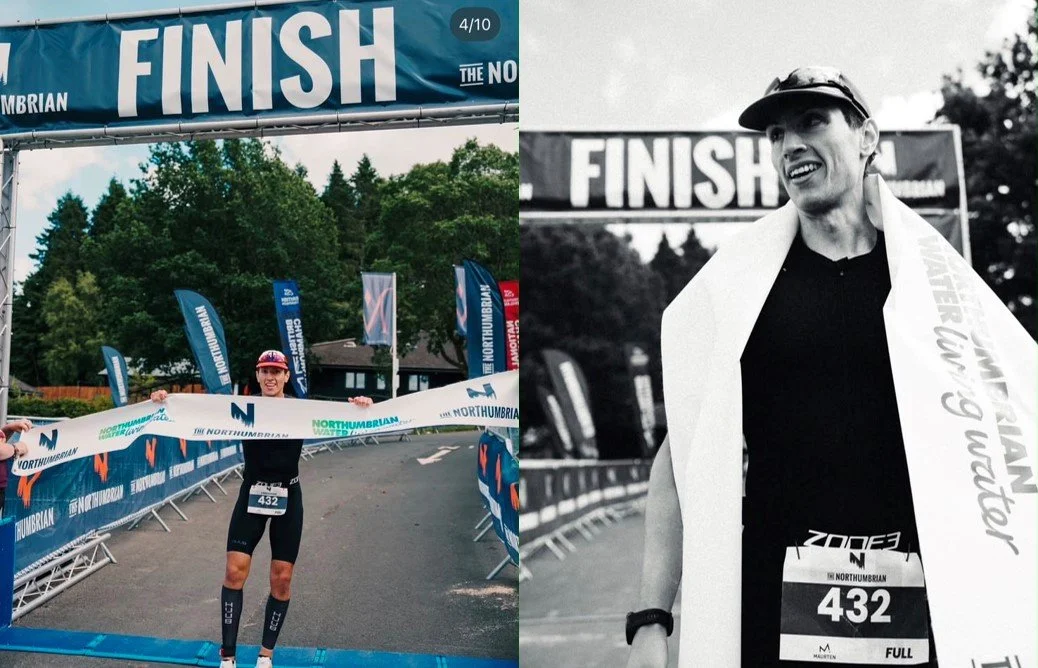
Northumbrian IM #1
So why should you do an Ironman a week before your Ironman?
You probably should not. But also, maybe you should.
If I had not had the bad swim at Northumbrian, I might have had it at Roth instead. That would have been about +12 minutes. The Northumbrian swim exposed an execution problem while there was still time to fix it. If I had not run 3h15 comfortably at Northumbrian, I might not have trusted 3h00 pace at Roth. That would probably have cost several more minutes. If I had not ridden Northumbrian in a controlled way, with stable power and limited heart rate drift, I would have had less confidence that the training had produced the durability I needed.
In theory, an Ironman one week before an Ironman is a terrible idea. In practice, it was a very specific stimulus: a full-distance technical rehearsal, metabolic validation, pacing calibration and confidence intervention. The key distinction is that it was not raced as a heroic depletion exercise. It was raced as a controlled long day with consequences.
There is a clear trend emerging here.
Maybe if I do another race this weekend, I can get under 9 hours.
